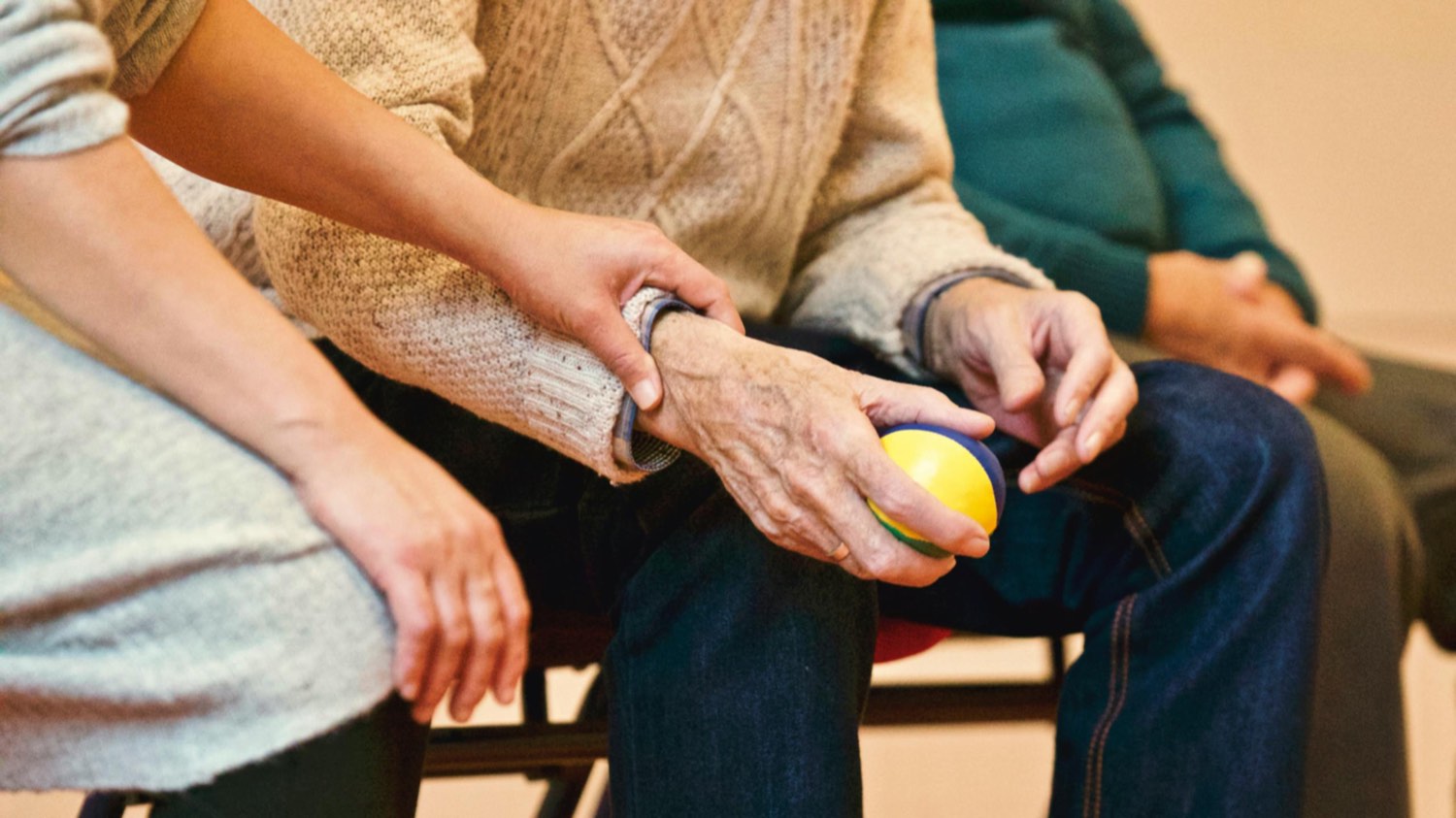
Across rural Europe, the problem is rarely that rehabilitation doesn’t exist. As ROSIA’s procurement coordinator Sofía Moreno-Pérez puts it, distance and workforce shortages make rehabilitation inaccessible for the people who need it most. In the Barbastro area of Aragon, with its mountains and scattered villages, the nearest rehabilitation centre can be a two-hour round trip for someone already struggling with mobility. Without enough patients to justify a specialist clinic, and without enough staff to run one, whole regions become service deserts: places where the care exists in principle but not in practice. For someone recovering from a stroke or a spinal cord injury, Moreno-Pérez notes, that is simply not sustainable as a long-term care model.
ROSIA (Remote Rehabilitation Service for Isolated Areas, GA 101017606, 2021 to March 2026) was built to answer that. The core idea was straightforward: if patients cannot reliably get to a rehabilitation clinic, bring the clinic to them through their screen, their phone or a wearable device. The consortium used pre-commercial procurement to challenge the market across three competitive phases, funding R&D at each stage, and delivered two telerehabilitation platforms, RAISE and Rehabilify, built and refined against real clinical requirements rather than chosen off the shelf.
The platforms were then piloted across Ireland, Portugal and Spain. Over ten months, 124 patients and 36 healthcare professionals used them across seven conditions. The most important result was that the systems worked, clinically and technically, across all three health systems at once. Getting a digital rehabilitation platform to function reliably across three different national contexts is the proof of concept that this approach can scale.
The clinicians are worth dwelling on. They started sceptical, with good reason, about whether older patients with complex conditions could manage the tools, and about what remote, technology-mediated rehabilitation meant for their own role. Then the remote monitoring began giving them more continuous visibility of patient progress than a clinic visit ever had, and the scepticism turned. The human arc matters more than the feature list: adoption is what proof of concept actually looks like.
The model did not come from a blank page. PPCN.xyz joined the consortium as knowledge partner, and its contribution was to fold two decades of virtual-care experience into the model’s design. That experience runs along a specific axis: Denmark, where connected and remote care reached the mainstream earlier and deeper than almost anywhere in Europe, and where Claus F. Nielsen worked inside that adoption through board roles in national interoperability; and the Gulf, where new care models are built on greenfield systems with no legacy to unwind and can be designed well from the start. ROSIA took the patterns that already work at both ends of that axis and adapted them to rural Europe’s constraints: older patients, thin connectivity, stretched workforces. The novelty was less in any single device than in the integration: a prescribable catalogue, an open platform, and a care pathway three different health systems could actually run.
And it shifts what procurement is for. ROSIA demonstrates how procurement itself can be used to innovate: rather than waiting for the market, a health system can commission exactly what it needs. That shift, from passive buyer to active shaper of the market, is the most transferable lesson from the project.
A proof of concept still has to become adoption, and ROSIA’s own positioning paper (D7.7, submitted to the European Commission, December 2025) is candid about why. The binding constraint is now regulatory. Digital therapeutics are regulated as medical devices under the MDR, but prescription and reimbursement are decided nationally, and the national frameworks diverge sharply: Germany’s DiGA, France’s PECAN, Belgium’s mHealthBelgium, the UK’s NICE EVA each impose different evidence, pricing and interoperability requirements. The consequence is stark: to date, no digital therapeutic has been reimbursed in more than one EU country.
The platform crosses borders, and the reimbursement stops at each one.
The constructive reading is that the paper also says what would change this, and none of it is exotic. These are architecture problems: load-bearing layers that have to be built for the clinical result to reach patients at scale:
- →Harmonised DTx pathways anchored in the EHDS.
- →Cross-border recognition of evaluations, so a solution assessed in France is not made to start from scratch in Germany.
- →Provisional reimbursement that lets real-world evidence accumulate.
- →A living assessment system that fits software that changes faster than annual review cycles can track.
That is the work ROSIA hands forward. The positioning paper frames the unfinished journey explicitly as the step from pre-commercial procurement to public procurement of innovation: from proving a solution can be built to committing to buy it at scale. That step is what Cronique, a PPI proposal now in development, is designed to take. It is not yet funded, and the problem is not solved. Cronique shows where the work goes next.
Europe’s ageing, depopulating regions will need remote care. ROSIA showed the technology is ready. The remaining question is whether the procurement and reimbursement architecture will be.